
It’s 5:30 PM on a chilly Tuesday, the table is set, and you realize the lasagna you tucked away an hour ago is still sitting in a cold, dark box. That sinking feeling of a ruined dinner is often followed by a wave of anxiety about repair costs and the dread of waiting for a technician who might not show up. When you need an oven not heating repair Ottawa experts can handle, you aren’t just looking for a fix; you’re looking for reliability. We understand that your kitchen is the centre of your home, and a broken appliance feels like a major disruption to your family’s rhythm.
You deserve a straightforward solution that favours honesty over a quick sale. We honour your trust by providing a clear path forward without the stress. In this guide, we’ll help you identify the common culprits behind a cold oven, from worn out igniters to faulty bake elements, while explaining our transparent diagnostic process. We’ll walk through the “repair versus replace” dilemma using local Ottawa insights for 2026, ensuring you have the clarity needed to make a fair, informed decision. By the time you’re done reading, you’ll know exactly how to restore your kitchen’s warmth without the technical jargon or hidden fees.
Key Takeaways
- Learn to distinguish between minor temperature fluctuations and total heating failure to help your technician pinpoint the issue quickly.
- Identify the common technical faults behind an oven not heating repair Ottawa homeowners face, including worn-out bake elements and weak igniters.
- Evaluate the “Repair or Replace” dilemma using the 50% rule to determine if a fix is a sound financial investment for your household.
- Understand the distinct safety requirements for gas versus electric units, including why specialized technical expertise is essential for gas-line repairs.
- Discover how a transparent, owner-operated approach provides the clarity and reliability you need to restore your kitchen’s heart without hidden fees.
Why Your Oven Stopped Heating: Common Symptoms and Causes
Is your oven displaying a cryptic error code, or is it just staying eerily silent? It is a common frustration for many families in our community. You set the temperature, the display lights up, and the clock begins to count down, but thirty minutes later, the air inside is still room temperature. This “cold oven” scenario is often the first sign you need an oven not heating repair Ottawa homeowners can rely on for a quick return to normalcy. Sometimes the failure is sudden and total. In other cases, you might notice a subtle shift toward uneven baking, where the top of your tray is scorched while the bottom remains doughy and undercooked.
In Ottawa, our dramatic seasonal temperature shifts can sometimes mask these early signs of appliance failure. During a frigid January, you might assume your oven is simply taking longer to preheat because the kitchen feels draftier. However, a healthy oven should reach its target temperature within a predictable window regardless of the weather outside. If you find yourself constantly adjusting cook times or rotating pans to compensate for “cold spots,” your appliance is likely sending a distress signal that requires professional attention before the component fails completely.
Visual Cues: What to Look for Before Calling a Tech
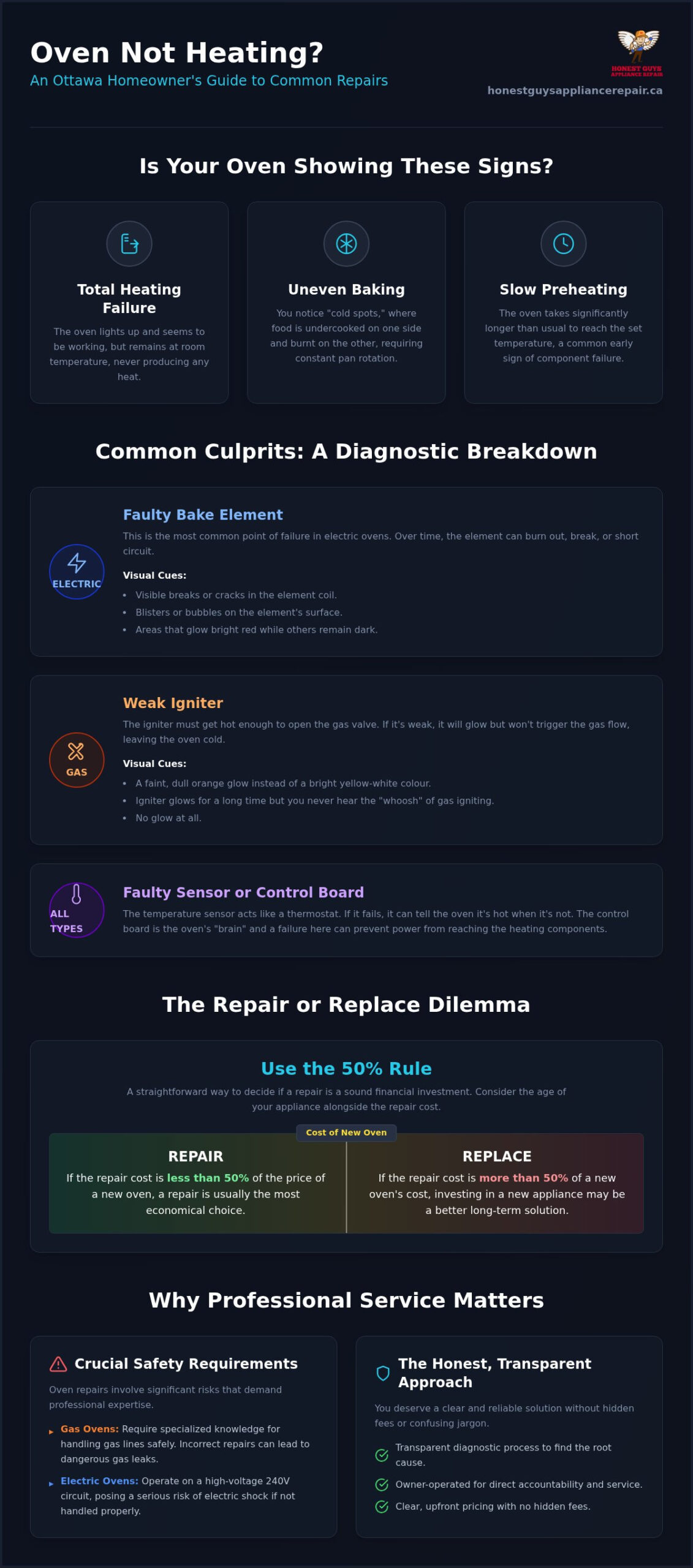
Before you reach for the phone, a quick visual inspection can provide valuable clues. For electric ovens, wait until the unit is completely cool and examine the bake element at the bottom. Do you see any visible breaks, blisters, or areas where the coil looks “thinned out”? These are clear indicators of a burnt-out element. If you own a gas oven, you can safely observe the igniter through the bottom vents. A functioning igniter should glow a brilliant yellow-white colour. If it only manages a dull, dark orange glow, it likely lacks the electrical resistance required to signal the gas valve to open.
Don’t overlook your electrical panel, especially if you live in one of Ottawa’s historic neighbourhoods like the Glebe or Westboro. Ovens require 240 volts of power. It’s possible for a breaker to “half-trip,” providing 120 volts which is enough to power the clock and internal lights, but not enough to energize the heating elements. Simply flipping the breaker off and back on can sometimes resolve this, but if it happens repeatedly, it’s a sign of a deeper electrical issue.
The Role of the Oven Control Board
The Electronic Oven Control (EOC) acts as the brain of your appliance, orchestrating every function from the self-clean cycle to precise temperature regulation. If you hear the familiar “click” of a relay but the oven stays cold, the control board might be failing to send voltage to the elements. This is a complex diagnostic because the board may appear perfectly functional from the outside. If your display is completely blank, the problem often lies with the power supply or a tripped thermal fuse rather than the heating circuit itself. We prioritize a methodical diagnostic process to ensure we’re fixing the actual root cause, saving you from the cost of unnecessary parts.
Diagnostic Breakdown: Is it the Element, Igniter, or Sensor?
When your kitchen goes cold, the first step is pinpointing which component has resigned from its duties. While modern ovens are more complex than their predecessors, the majority of heating failures stem from a few usual suspects. In our experience providing oven not heating repair Ottawa families trust, we find that the bake element, the igniter, or a faulty sensor usually holds the answer. Understanding these parts helps you describe the problem clearly when you call for help.
The bake element is the heavy lifter of an electric oven. Operating on a 240V circuit, it undergoes immense thermal stress every time you preheat. Over time, the internal wire can break or short out against its outer casing. If your oven “thinks” it is heating because the sensor is working, but the air stays cool, the element is the likely culprit. Conversely, if your oven is gas-powered, the igniter is the most common point of failure. It must draw a specific amount of electrical current to open the gas safety valve; even if it glows, it might not be strong enough to trigger the flow of gas.
Then there is the temperature sensor. This small probe acts as a thermostat. If it fails or drifts out of calibration, it might signal the control board that the oven has reached 400°F when it is actually only 75°F. For safety, many units also include a thermal fuse. If the oven ever overheats, this fuse blows to cut power to the heating circuit entirely. This prevents a fire but leaves you with a cold appliance that won’t respond to any settings.
Electric Oven Heating Elements
A burned-out element doesn’t just stop heating; it can sometimes trip your home’s breaker if it shorts out. You might notice the broil element at the top still works while the bottom bake element stays cold. We always recommend using genuine OEM elements. These are designed specifically for your model’s wattage and fit, ensuring better longevity and safety than generic alternatives. If you aren’t sure which part is failing, a quick diagnostic visit from a local professional can save you from the guesswork of ordering the wrong part.
Gas Oven Ignition Systems
Gas ignition is a delicate balance of electricity and fuel. A glow-bar igniter must pull enough amps to heat the safety valve’s internal bimetal strip. If the igniter is weak, the valve stays shut as a safety precaution. Older Ottawa ranges might also suffer from a failing safety valve itself, which requires specialized leak-detection equipment to diagnose. Because gas repairs involve your home’s fuel lines, they require a technician with the right tools to ensure every connection is airtight and safe for your family.
Electric vs. Gas Ovens: Distinct Fault Paths for Ottawa Homes
Whether you live in a newer development in Kanata or a more established home in Stittsville, the way your oven generates heat depends on a specific set of technical paths. Electric units rely on high-voltage circuits and precise grounding, while gas units operate at the critical intersection of electricity, gas flow, and ventilation. When searching for an oven not heating repair Ottawa homeowners often discover that the solution is rarely universal. For instance, many homes in the west end feature specific gas manifold setups that require a nuanced understanding of local infrastructure. If you ever smell gas while troubleshooting, stop immediately. Turn off the gas supply valve, open your windows, and leave the area before calling for help. Safety is our absolute priority.
Electric ovens are high-voltage machines that demand respect. A failure in the grounding system can sometimes lead to intermittent heating or even damage to the control board. In contrast, gas ovens are often more complex because they require a perfect sequence of events: the igniter must draw enough power, the safety valve must open, and the venting must be clear to prevent carbon monoxide buildup. If any part of this chain breaks, the unit will stay cold as a safety precaution.
TSSA Regulations in Ontario
In Ontario, the Technical Standards and Safety Authority (TSSA) sets strict rules for who can work on gas-fired appliances. This isn’t just red tape; it’s about protecting your household from leaks and fire hazards. Only a licenced gas technician should ever touch your oven’s gas line or internal gas components. If a technician finds a safety violation, they are legally required to issue a “Red Tag.” This means your gas service to that appliance must be shut off until the fault is corrected and the unit is brought back to provincial safety standards. We take these regulations seriously to ensure every home we visit remains a safe environment.
Common Brand Faults in the Ottawa Market
Our team sees certain patterns across the brands popular in Ottawa kitchens. Samsung and LG models frequently experience issues with their electronic control boards or temperature sensors, which can lead to “ghost” heating where the display says it’s hot but the element is cold. Whirlpool and Maytag units are known for their reliable, classic bake element designs, making them some of the most straightforward repairs we handle. High-end Bosch units often present more complex challenges, such as convection fan failures or heating sync issues where the multiple elements fail to work in harmony. Understanding these brand-specific quirks allows us to arrive prepared with the right diagnostic tools for your specific model.
The ‘Repair or Replace’ Dilemma: A Straight-Talk Guide
How do you know when a repair is a smart investment or just throwing good money after bad? It is a question we hear from almost every homeowner facing an oven not heating repair Ottawa dilemma. We use a straightforward framework called the 50% rule to help you decide. If the estimated repair cost exceeds 50% of the price of a brand-new, comparable unit, and your appliance is already past the halfway point of its expected lifespan, it is usually time to consider a replacement. However, for high-end units or ovens in excellent physical condition, a repair is often the most logical choice.
Beyond the dollars and cents, repairing your appliance is the greener choice for our Ottawa community. Keeping a heavy range out of the landfill reduces environmental waste and saves the energy required to manufacture and ship a new unit. We always look at the overall condition of your range during our visit. Are the door seals still airtight? Do the hinges move smoothly? Is the cooktop surface free of deep cracks? If the body of the range is solid, replacing a single component like a bake element is a fantastic way to extend its life for several more years.
Average Lifespans of Modern Ovens
Today’s ovens are packed with smart features and electronic sensors, but these components can be more delicate than the mechanical parts of the past. Electric ovens typically last between 13 and 16.8 years, while gas ranges often reach 14.5 to 17 years. The “Golden Years” for a repair are generally between years five and ten. This is when the unit is out of warranty but still has plenty of life left. Be cautious with frequent self-cleaning cycles, though. The extreme heat required for self-cleaning can sometimes damage sensitive control boards, leading to premature failure and a cold oven.
Cost Considerations for Ottawa Families
When you price out a new oven, remember that the sticker price is only the beginning. You must also factor in delivery fees, removal of the old unit, and professional installation costs. These extras can add a surprising amount to your total bill. This makes the value of professional electric stove repair in Ottawa even clearer. Our goal is to provide an honest diagnostic that prevents unnecessary part-swapping. We believe in transparency, which means telling you clearly when a repair doesn’t make financial sense. If you are struggling to decide, you can book a professional assessment to get a clear, expert opinion on the health of your kitchen’s heart.
Professional Oven Repair in Ottawa: The Honest Guys Difference
Finding a technician you can trust shouldn’t be as hard as the repair itself. When you search for an oven not heating repair Ottawa service, you’re looking for more than just a set of tools; you’re looking for peace of mind. As an owner-operated business, we don’t hide behind a corporate call centre or a complex web of dispatchers. Every job carries our personal reputation and a commitment to the craftsmanship we’ve honed since 2017. We serve our neighbours across the entire region, from the quiet streets of Stittsville and the family-friendly corners of Barrhaven to the growing communities in Orleans and Nepean. Our “Honest” guarantee is the core of our brand. If we wouldn’t justify the cost of a specific repair in our own home, we won’t recommend it for yours. Transparency is our foundation, which means you’ll never see a surprise labour charge or a hidden fee on your final invoice.
Our Methodical Diagnostic Process
We don’t believe in guesswork. Our diagnostic process is logical and thorough, designed to find the root cause of the failure rather than just treating the symptoms. We begin with power testing at the source to ensure your appliance is receiving the correct voltage. From there, we systematically isolate components like the thermal fuse, the bake element, and the control board relays. To minimize the time your kitchen is out of commission, we keep our service vehicles stocked with high-quality parts for major brands like GE, Whirlpool, and Frigidaire. This preparation often allows us to complete the repair during our initial visit. Before we consider the job done, we perform a series of final safety checks. We verify that the oven is calibrated to the correct temperature and ensure that gas units are completely leak-free and venting properly.
Book Your Ottawa Oven Repair Today
We understand that modern life is fast-paced and a broken appliance is a major hurdle. Whether you’re a busy family in Kanata or a professional in Gloucester, we make the scheduling process as painless as possible. We value your time and prioritize clear communication from the moment you reach out. If you live in the south end, you might find our homeowner’s checklist for Barrhaven useful for keeping your entire household running smoothly. Don’t let a cold oven ruin another evening or force you into another week of takeout. We are ready to restore the warmth and functionality to your kitchen with the integrity your home deserves. Schedule your professional oven diagnostic now and see why your neighbours trust us to keep their kitchens at the heart of the home.
Restore the Heart of Your Kitchen Today
A broken oven is a major disruption, but it doesn’t have to be a source of long-term stress. You now have the tools to identify whether a faulty igniter, a burnt-out element, or a simple sensor drift is behind your kitchen’s cold spell. By applying the 50% rule, you can make a confident financial choice that respects your budget and the environment. We’ve been owner-operated since 2017, providing the specialized TSSA-licenced gas expertise and transparent, no-fluff pricing that families across our city deserve. Whether you’re in Kanata or Orleans, our goal is to provide clarity and technical precision without the jargon.
If you’re ready for an oven not heating repair Ottawa homeowners can trust, we’re here to help. Our methodical diagnostic process ensures your unit is safe, calibrated, and ready for your next family meal. Book Your Honest Oven Diagnostic in Ottawa and let’s get your home back to its best. Your kitchen will be warm again before you know it.
Frequently Asked Questions
Why is my oven taking so long to preheat?
Your oven likely has a failing bake or broil element that is no longer reaching its full temperature. Most modern units use both elements to preheat quickly; if one is burnt out, the other must work twice as hard to reach the target. This results in sluggish performance and uneven heat distribution. A faulty temperature sensor could also be providing inaccurate readings to the control board, causing the preheat cycle to stall prematurely.
Is it safe to use my oven if the bake element is sparking?
No, you should immediately turn off the oven and flip the breaker to stop the flow of electricity. Sparking indicates a short circuit where the internal heating wire has breached the outer protective casing. This creates a fire hazard and can cause permanent damage to your oven’s electronic control board. We recommend leaving the unit powered down until a professional can perform an oven not heating repair Ottawa residents can trust for safety.
Can I replace an oven igniter myself?
While some homeowners attempt DIY repairs, replacing a gas igniter in Ontario requires a TSSA-licenced technician. Gas appliances involve complex connections where even a small error can lead to dangerous fuel leaks. For electric units, the high voltage involved makes professional service the safer choice for your household. We prioritize precision and safety, ensuring your new igniter is properly calibrated to draw the correct amperage for your specific safety valve.
Why does my oven smell like gas when I turn it on?
A faint smell of gas during the first few seconds of ignition is normal, but a persistent odour suggests a weak igniter or a leak. If the igniter takes too long to reach the required temperature, gas can build up in the oven cavity before it finally lights. This creates a dangerous delayed ignition scenario. If the smell is strong, shut off the gas supply and contact a professional technician immediately to ensure your home remains safe.
How much does a typical oven repair cost in Ottawa?
The total cost depends on the specific parts required and the complexity of the labour involved. While industry averages vary across Ontario, we focus on providing a transparent diagnostic process that eliminates the guesswork. We’ll provide you with a clear, upfront quote before any work begins so you aren’t surprised by hidden fees. This honest approach ensures you can decide if the repair is a sound financial investment for your home.
Does Honest Guys repair both gas and electric ovens?
Yes, we provide expert service for both gas and electric ranges across the greater Ottawa area. Our team holds the necessary TSSA licensing to safely handle gas line connections and internal ignition components. Since 2017, we’ve focused on being a reliable, neighbourly resource for homeowners in Kanata, Barrhaven, and beyond. Whether you’re dealing with a high-voltage electrical fault or a complex gas flow issue, we have the technical expertise to help.
Will a failed thermal fuse prevent the oven from heating?
A blown thermal fuse will definitely stop your oven from heating because it is designed to cut power to the heating circuit if the unit gets too hot. This safety device prevents fires during a runaway heating event or a failed self-cleaning cycle. Once the fuse blows, it cannot be reset and must be replaced. We’ll also investigate why the oven overheated in the first place to prevent the new fuse from failing again.
What should I do if my oven shows an F-code or error message?
You should first record the specific code and try resetting the oven by flipping the breaker for one minute. If the code returns, it’s a diagnostic signal from the control board indicating a specific fault, such as a shorted sensor or a stuck keypad. Providing this code to us when you call for an oven not heating repair Ottawa service helps our technicians arrive prepared with the specific components your model likely needs for a fix.