
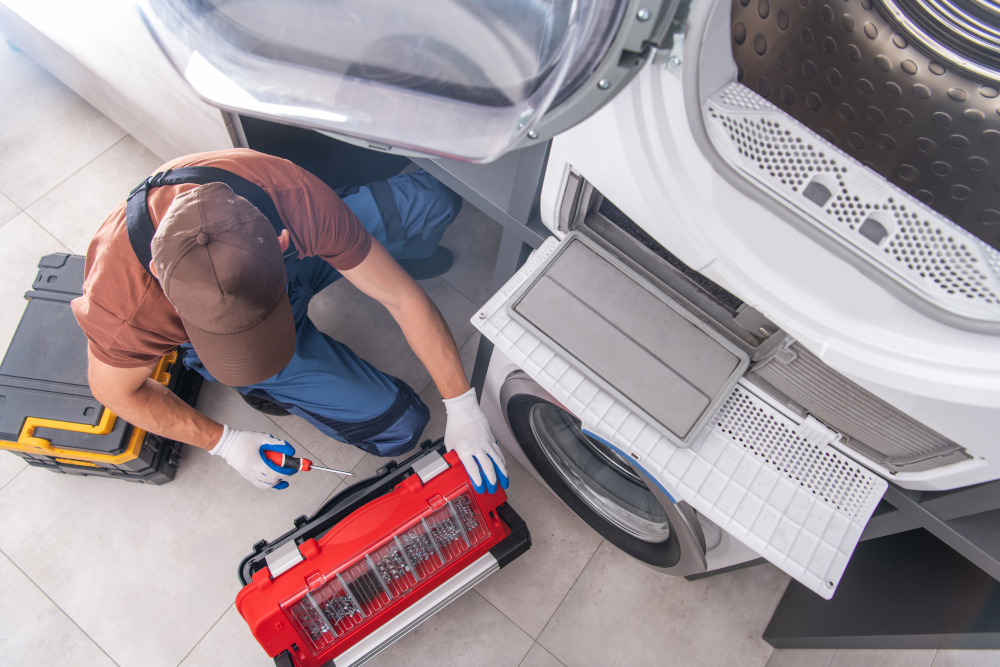
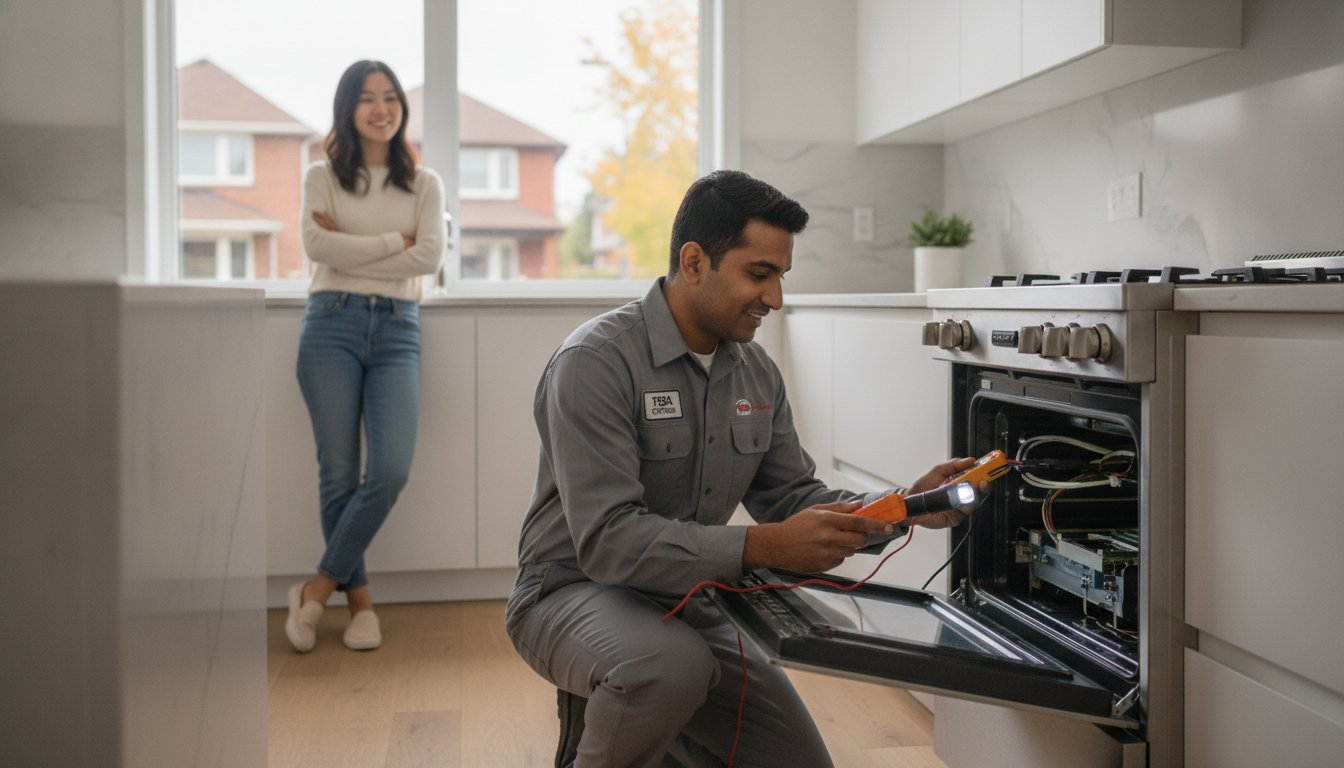
You have the table set and the family is hungry, but when you turn the dial, your gas oven stays cold and silent. It’s more than just a ruined meal. It’s a source of genuine anxiety when you start wondering if that faint smell is a leak or if a repair will break the bank. We understand that feeling of uncertainty. When you’re dealing with gas oven repair Ottawa homeowners often feel caught between the urgency of a hot meal and the fear of a safety hazard.
We want to help you regain your peace of mind by showing you exactly how to identify common malfunctions and when it’s safe to troubleshoot. You’ll learn about the latest TSSA safety regulations effective as of June 2026, including the mandatory carbon monoxide alarm requirements for every storey of your home. This guide provides a clear, logical path forward. We’ll explain why a TSSA-certified technician is essential for a safe, working oven and how to get your kitchen back to normal with the help of a local expert who truly cares about your family’s well-being.
Key Takeaways
- Learn to spot common symptoms like a glowing igniter that fails to light, helping you realize when your appliance needs professional attention.
- Understand why gas oven repair Ottawa services must be performed by TSSA-certified technicians to comply with Ontario safety laws and protect your home.
- Define the “Safe Zone” for basic maintenance and recognize the “Danger Zone” where complex components like gas valves require expert handling.
- Discover simple steps to safely manage malfunctions, such as allowing the unit to cool and cleaning burner ports to restore proper airflow.
- Find out how to access reliable, local repair experts in Kanata, Stittsville, and Orleans who prioritize straight-talk pricing and your family’s safety.
Identifying Common Gas Oven Issues in Ottawa Kitchens
Professional gas oven repair Ottawa homeowners can trust involves more than just swapping parts. It is the careful restoration of the heating and ignition systems that ensure your appliance operates with precision and safety. You might think a broken oven simply won’t turn on, but the signs of failure are often more subtle and frustrating. Recognizing these symptoms early can prevent a minor inconvenience from becoming a major safety concern for your family. Understanding how these systems fail is the first step toward a safe and functional kitchen.
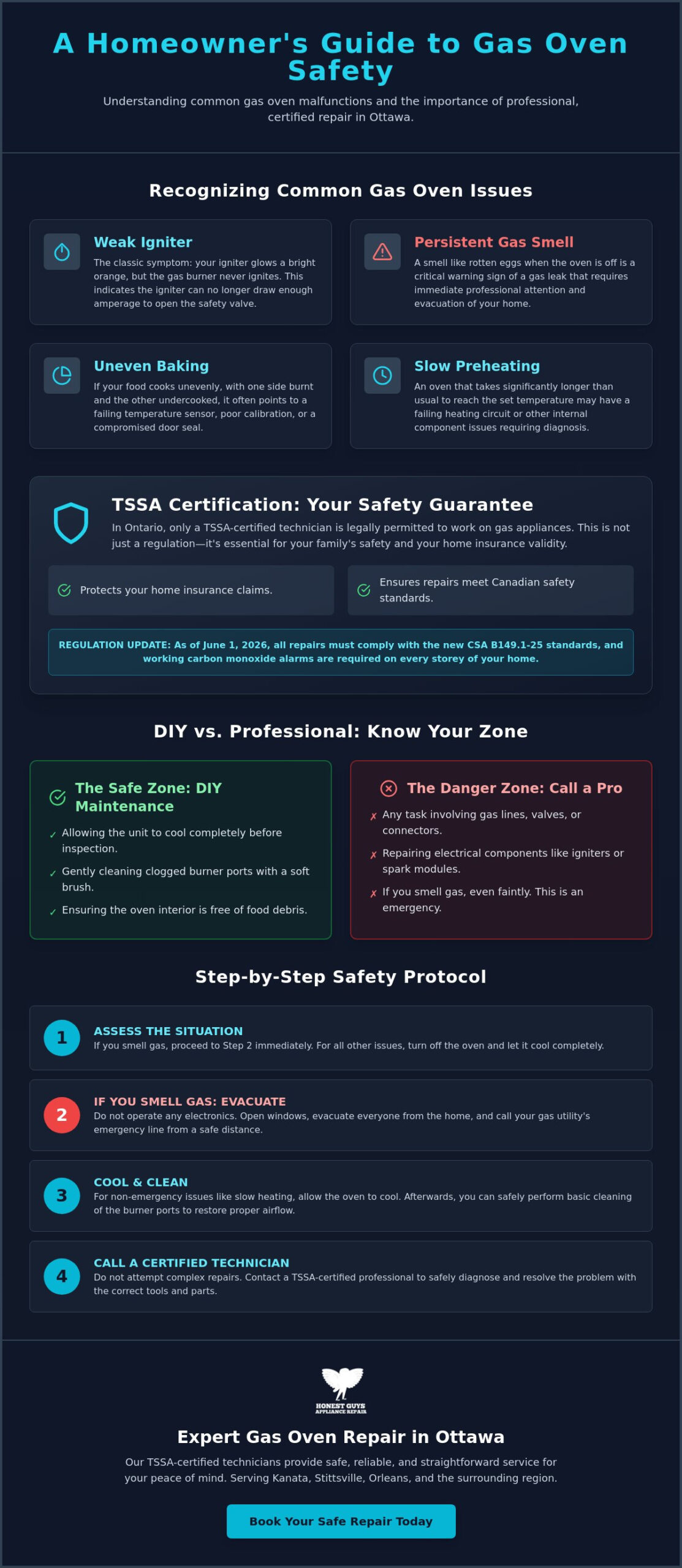
- The igniter glows but the burner never lights: This is a classic sign of a weakened igniter that can no longer trigger the gas valve.
- A persistent smell of gas: If you notice a scent like rotten eggs while the oven is off, you likely have a leak that needs immediate professional attention.
- Uneven baking: When your cakes rise on one side but stay flat on the other, your oven’s temperature sensors or calibration may be failing.
- Slow preheating: An oven that takes twenty or thirty minutes to reach temperature is struggling with a failing heating circuit or a compromised door seal.
When Your Oven Refuses to Ignite
Modern gas ovens rely on a glow bar igniter to start the cooking process. This component must reach a specific temperature to draw enough electrical current to open the gas safety valve. If the igniter is old or damaged, it might still glow bright orange, but it won’t draw the amperage required to release the gas. You might realize the igniter is failing if you hear the “click” of the valve but never see a flame. This connection between the ignition circuit and the safety valve is a critical fail-safe designed to prevent unburned gas from filling your kitchen. When gas oven repair Ottawa experts arrive, checking this amperage is often the first priority.
Strange Noises and Smells: Warning Signs
Hearing a soft “poof” when your oven ignites is standard, but a loud bang or a delayed “whoosh” suggests a dangerous build-up of gas before ignition. This is often caused by clogged burner ports or a misaligned igniter. If you find that your gas stove smells like gas when off Ottawa homeowners should act quickly to secure their home. Throughout the history of gas stove safety, manufacturers have added layers of protection, yet parts like spark modules can still fail. If you hear a constant clicking sound that won’t stop, it usually indicates a faulty module or a shorted ignition switch that requires expert diagnosis to resolve safely.
The Importance of TSSA-Certified Gas Oven Repair
When you’re searching for gas oven repair Ottawa, you might see local advertisements for general handymen offering quick fixes at lower rates. Don’t be tempted by these shortcuts. In Ontario, working on gas-fired appliances is a strictly regulated activity for a very good reason. The Technical Standards and Safety Authority (TSSA) is the provincial body responsible for enforcing fuel safety. They ensure that every technician who handles gas lines in your home has completed the necessary training and testing to keep your family safe.
Why is this legal restriction so important? It’s about accountability and precision. Legally, only a licensed gas fitter can disconnect, repair, or install gas equipment in Ottawa. If an uncertified individual performs work on your oven and a fire or leak occurs later, your home insurance provider may completely deny your claim. They view uncertified work as a breach of standard safety protocols. Choosing a certified professional isn’t just about getting the oven to heat up again; it’s about protecting your home and your peace of mind.
Safety Standards for Ottawa Homeowners
A professional technician does more than just replace a part. They ensure your kitchen meets specific Canadian ventilation requirements to prevent the buildup of harmful gases. With the new TSSA regulations effective as of June 1, 2026, all repairs must comply with the updated CSA B149.1-25 standards. During a service call, a certified expert will use calibrated tools to check for carbon monoxide leaks. This is especially critical now that Ontario law requires working carbon monoxide alarms on every storey of your home. Using manufacturer-approved connectors and gas lines is a non-negotiable part of our process to ensure the longevity of the repair.
Verifying Your Technician’s Credentials
How can you be sure you’re hiring a legitimate expert for your centre-town home? Start by asking for their TSSA registration number before they begin any work. A valid registration is a clear sign that the company follows provincial safety laws. You can even verify these credentials directly on the TSSA website to be certain. At Honest Guys Appliance Repair, we prioritize transparency in everything we do, from our licensing to our insurance coverage. We believe you deserve a neighbourly professional who treats your home with respect. If your appliance is acting up, we provide the reliable oven repair you need with the “straight-talk” honesty you expect.
DIY Troubleshooting vs. Professional Repair: Making the Right Choice
Is it a simple fix or a serious safety hazard? This is the question every homeowner asks when their appliance fails. We believe in empowering you with the right information so you can make a decision that protects your family and your wallet. While some minor maintenance is perfectly safe for a DIY approach, gas oven repair Ottawa residents must realize that anything involving the gas manifold or internal valves is strictly professional territory. Safety should always come before a weekend project.
The “Safe Zone” includes tasks that don’t require opening gas lines or testing live circuits. For example, cleaning the interior or checking the door alignment is helpful maintenance. However, the “Danger Zone” begins the moment you need a wrench for a gas fitting or a multimeter for the safety valve. Attempting these repairs yourself doesn’t just risk a leak; it can lead to costly mistakes that turn a simple part replacement into a total appliance failure. A professional diagnostic provides clarity and a fixed path forward, often saving you more money than the “guess and check” method of buying parts online.
What You Can Safely Check Yourself
Before you call for help, perform these basic checks to rule out simple issues. First, verify the power supply. Many modern gas ovens require electricity to power the digital control board and the igniter. If the clock is blank, check your circuit breaker. Next, examine the oven door seal. A torn or brittle gasket allows heat to escape, causing uneven cooking. Finally, ensure the gas shut-off valve behind the unit is fully in the “on” position. Sometimes these valves are bumped during cleaning, cutting off the fuel supply without you realizing it.
When to Call the Pros Immediately
Certain symptoms are clear signals that you need an expert. If your oven is not heating even though the igniter is glowing bright orange, the safety valve has likely failed. This requires a TSSA-certified technician to diagnose and replace. You should also step away and call us if you hear a persistent hissing sound near the back of the oven or if the control board displays a cryptic error code like “F1” or “F3.” These codes often point to internal sensor failures or board malfunctions that require precise technical knowledge to resolve. If your oven is more than ten years old and the repair cost exceeds half the price of a new unit, we’ll give you an honest assessment of whether a replacement is the better long-term investment for your Ottawa home.
Step-by-Step: How to Safely Handle Oven Malfunctions
When your appliance starts behaving unexpectedly, it’s easy to feel overwhelmed. Following a methodical process keeps you safe and helps us get your kitchen back in order faster. Before you search for gas oven repair Ottawa services, there are several steps you can take to secure your home and gather the information a technician will need. This organized approach ensures that when a professional arrives, they have the clear data required to provide an efficient and accurate solution.
- Step 1: Turn off the oven immediately and allow it to cool completely. Never attempt to inspect a hot unit, as metal surfaces and internal components can cause severe burns.
- Step 2: Clean the burner ports. Ensuring proper gas flow and aeration is often the simplest way to resolve minor heating issues.
- Step 3: Test the broiler. If the broiler ignites but the bake burner does not, you’ve successfully isolated the issue to a specific ignition circuit or burner tube.
- Step 4: Check the thermostat calibration. Using an external oven thermometer will tell you if the internal sensor is reading accurately or if it has drifted over time.
- Step 5: Document specific symptoms. Write down any error codes, strange smells, or unusual sounds. This helps your technician arrive prepared with the right parts.
Cleaning Burner Ports for Better Performance
Built-up grease and food debris are common culprits for uneven heating. These obstructions block the small orifices where gas exits, preventing a consistent flame. When cleaning, use a soft brush or a thin wire to gently clear the ports. Avoid using wooden toothpicks or matches, as they can snap off and create a permanent blockage. Maintaining clean burners is a universal rule for kitchen safety, much like the regular maintenance required for electric stove repair Ottawa residents often overlook until a spill causes a short circuit. A clear path for gas or heat ensures your appliance operates at peak efficiency.
Calibrating Your Oven Temperature
If your recipes aren’t turning out quite right, your oven might simply be out of sync. You can perform a “sugar test” by placing a small amount of sugar on a foil-lined tray; since sugar melts at exactly 366°F (186°C), it serves as a natural indicator. Alternatively, a digital thermometer provides a more precise reading. Most modern digital control panels allow you to adjust the temperature offset by a few degrees. However, if you find a discrepancy of more than 35 degrees, it likely indicates a failing temperature sensor or a compromised control board. If you’re noticing significant temperature swings, it’s time to schedule your professional diagnostic with an expert who can restore your oven’s precision safely.
Reliable Gas Oven Repair Services Across the Ottawa Region
Your kitchen is the heart of your home. When your oven fails, it disrupts more than just your dinner plans; it affects your family’s daily rhythm and sense of security. We believe that finding professional gas oven repair Ottawa residents can rely on should be a straightforward, stress-free experience. As an owner-operated local business, we take personal accountability for every service call. We don’t just see a broken appliance; we see a neighbour who needs help. This community-first approach is why we prioritize “straight-talk” pricing. You’ll receive a clear explanation of the work required and an honest quote with absolutely no hidden fees or surprise surcharges.
Urgency matters when gas is involved. We understand that a malfunctioning oven can’t always wait. Our team is structured to handle urgent repair needs across the city, ensuring that your home returns to a safe, functional state as quickly as possible. By choosing a local expert, you’re gaining the peace of mind that comes from a technician who understands the specific needs of Ottawa households and values the long-term safety of the community. Whether you are in Kanata, Stittsville, or Orleans, we are committed to delivering results that last.
Serving Nepean, Barrhaven, and Beyond
Our commitment to excellence extends to every corner of the capital. Whether you’re in the established neighbourhoods of Gloucester and Nepean or the rapidly growing communities of Findlay Creek and Barrhaven, we are ready to assist. Local knowledge is a vital part of our service. We understand the differences between the gas configurations in older Ottawa homes and the high-efficiency systems found in newer builds. To ensure we respect your time, our mobile repair units are fully stocked with high-quality, manufacturer-approved parts for most major brands. This preparation allows us to resolve many issues during the very first visit, minimizing the time your kitchen is out of commission.
Book Your Honest Diagnostic Today
We follow a methodical process that begins the moment you call. From the initial symptom assessment to the final safety check, we leave nothing to chance. Every repair we perform includes a comprehensive warranty on both parts and labour. We stand behind our craftsmanship because we realize that your trust is earned through consistent, high-quality results. It’s about more than just a working appliance; it’s about the safety of your household. Don’t risk your family’s well-being or the integrity of your home with a faulty gas appliance. If you notice any of the warning signs we’ve discussed, reach out to a professional who puts your safety first. Let’s get your oven working safely so you can get back to cooking for the people you love.
Restore Safety and Comfort to Your Kitchen
Your family’s safety is the most important factor when your kitchen appliances fail. You now realize how to spot the difference between a minor maintenance task and a complex gas issue that requires professional intervention. By choosing a TSSA licensed technician, you ensure your home stays compliant with Ontario’s strict safety codes while protecting your insurance coverage. We take pride in serving our neighbours in Kanata, Nepean, and Orleans with transparent, no-haggle pricing that respects your household budget. There’s no reason to let a faulty appliance disrupt your home life or cause unnecessary stress any longer.
When you need expert gas oven repair Ottawa homeowners trust for reliability and integrity, we’re ready to provide a clear path forward. Our team offers the calm competence required to resolve malfunctions quickly and safely. Don’t take chances with gas lines or complex ignition systems. Book Your Professional Gas Oven Repair in Ottawa Now and let us handle the technical details. We look forward to getting your kitchen back to its best and restoring your peace of mind. Your home deserves the care of a local expert who truly values your well-being.
Frequently Asked Questions
Is it safe to use my gas oven if the igniter is clicking but not lighting?
No, it is not safe to continue using your oven if the igniter clicks repeatedly without lighting the burner. This indicates a delay in the ignition process, which allows gas to accumulate inside the oven cavity. When it finally does ignite, the buildup can cause a sudden, forceful mini-explosion that may damage the unit or cause injury. You should turn off the gas supply and seek professional help immediately.
How much does gas oven repair typically cost in Ottawa?
The cost for gas oven repair Ottawa residents typically pay depends on the specific component failure and the complexity of the job. While we cannot provide fixed pricing here, common factors include the cost of manufacturer-approved parts like igniters or safety valves and the labour rate of a TSSA-certified technician. We always provide a transparent, no-haggle quote after a thorough diagnostic to ensure you understand the scope of the work.
Why does my gas oven take so long to preheat?
A slow preheat is often the result of a weakened glow bar igniter that takes too long to reach the temperature required to open the gas safety valve. Other culprits include a faulty temperature sensor that misreads the internal heat or a compromised door seal that allows hot air to escape. If your oven takes significantly longer than fifteen minutes to reach 350°F, an expert should inspect the heating circuit for precision.
Do I need a TSSA-licensed technician for gas stove repair in Ontario?
Yes, Ontario law strictly requires a TSSA-licensed technician for any work involving gas-fired appliances. This regulation exists to ensure that high-pressure gas lines and sensitive safety valves are handled with the necessary technical precision. Hiring an uncertified individual is dangerous and can void your home insurance policy. Always verify a technician’s G2 or G1 license before any work begins on your gas stove or oven.
How can I tell if my gas oven is leaking carbon monoxide?
Carbon monoxide is odourless and colourless, making it impossible to detect without technology. The most reliable way to tell if your oven is leaking is through a working carbon monoxide alarm, which is now legally required on every storey of your Ottawa home. Physical warning signs include unexplained headaches, dizziness, or nausea while the oven is running. If your alarm sounds, evacuate your home immediately and call emergency services.
What is the difference between a gas oven igniter and a spark module?
A gas oven igniter is typically a glow bar that reaches a high temperature to ignite the gas, whereas a spark module is an electronic component that generates high-voltage pulses to create a spark. Most modern ovens use a glow bar for the bake and broil burners and spark ignition for the top surface burners. Both components are essential for safe operation, but they fail in different ways and require specific diagnostic tools.
Can I convert my electric stove hookup to gas in my Ottawa home?
You can convert your electric stove hookup to gas, but this requires the installation of a dedicated gas line by a licensed gas fitter. This process involves more than just swapping the appliance; it requires proper venting, a shut-off valve, and a leak test that complies with current TSSA codes. It is a significant upgrade that adds value to your home but must be handled by a professional to ensure total safety.
How long should a gas oven igniter typically last before needing replacement?
A gas oven igniter typically lasts between four and seven years depending on how frequently you use your appliance. Because these components are made of fragile silicon carbide or silicon nitride, they naturally degrade and become brittle over time. If you notice your oven takes longer to light or if the igniter glows but the burner fails to ignite, it is likely reaching the end of its functional life and needs replacement.