
Does your kitchen still smell like last Tuesday’s fish dinner even though the windows have been open for hours? It is a common frustration for homeowners in neighbourhoods from Kanata to Orleans, but lingering odours are often just the tip of the iceberg. Improper hood fan installation in Ottawa can lead to thick grease buildup on your cabinetry and, more dangerously, hidden moisture trapped in your attic. You deserve a kitchen that breathes as easily as you do.
We realize that figuring out CFM ratings and duct sizes often feels like learning a second language. It is stressful to worry if your ventilation meets the updated Ontario Building Code or if a DIY mistake might cause structural issues. This guide simplifies the entire process. We promise to show you how a professional installation improves your indoor air quality and protects your home’s envelope. We will explore the latest quiet-first technology, explain the 100 CFM minimum exhaust rate requirements, and help you decide when it is time to call in a local expert for a seamless, reliable setup.
Key Takeaways
- Learn how a properly installed hood fan acts as your kitchen’s primary defence against grease and carbon monoxide while protecting expensive cabinetry from moisture damage.
- Understand why insulated ducting and backdraft dampers are essential for Ottawa’s climate to prevent attic condensation and keep winter drafts out of your home.
- Discover how to calculate the correct CFM for your stove to ensure your hood fan installation Ottawa project meets the 2026 Ontario Building Code requirements.
- See what goes into a professional site assessment, from verifying structural support to mapping out the most efficient duct paths for maximum performance.
- Find out why a transparent approach to ductwork and local expertise in neighbourhoods like Kanata and Barrhaven ensures a reliable, no-surprises installation.
The Critical Role of Range Hoods in Modern Ottawa Kitchens
When you’re planning a kitchen upgrade, it is easy to get caught up in countertop colours or backsplash tiles. However, the most vital component for the longevity of your home is often the one you see the least. To understand what is a range hood, you have to look beyond the fan itself. It is your home’s primary defence against airborne grease, steam, and carbon monoxide. Without it, these byproducts of cooking settle on your surfaces, creating a sticky film that is nearly impossible to clean and can eventually damage your finishes.
Think about your investment in custom cabinetry. High-quality wood is sensitive to moisture. Over time, the steam from a boiling pot can warp doors and peel expensive finishes. In Ottawa’s well-insulated, modern homes, this moisture has nowhere to go. Proper ventilation isn’t just about smell; it is about preserving your property and your health. Poor indoor air quality can lead to respiratory issues, especially in airtight houses that don’t breathe well on their own. A professional hood fan installation Ottawa ensures that these pollutants are removed effectively, rather than just moved around the room. Beyond the health benefits, a sleek, professionally installed unit adds significant aesthetic value, acting as a polished centrepiece for your renovation.
Under-Cabinet vs. Wall-Mount vs. Island Hoods
Choosing the right style depends on your kitchen’s layout and your specific venting goals. Each type comes with its own set of installation challenges that require a steady hand and technical knowledge.
- Under-cabinet: These are the space-saving workhorses of Canadian kitchens. They fit neatly beneath your cabinets and are generally the most straightforward to replace if the existing ductwork is in good shape.
- Wall-mount (Chimney style): These make a bold design statement. They require more wall space because the cabinets are removed to let the chimney reach the ceiling, often requiring precise wall repairs and electrical adjustments.
- Island hoods: These are the most complex. Because they hang from the ceiling over an open-concept island, they require specialized structural support and intricate ducting that must run through the ceiling joists.
Recirculating vs. Vented Systems
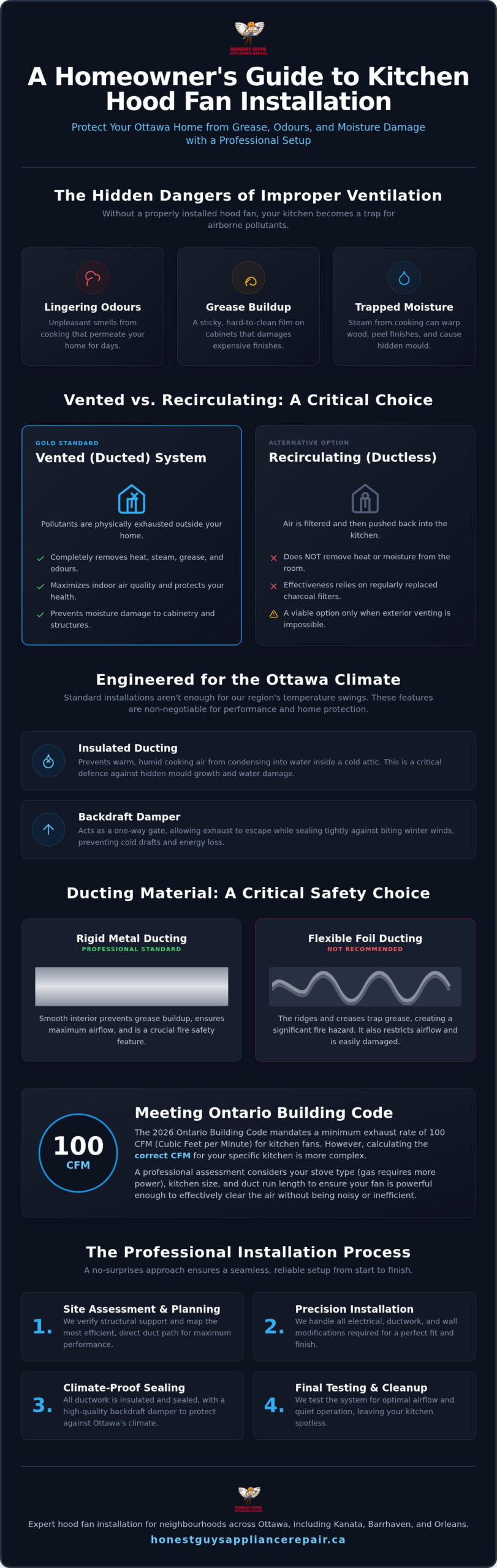
Most homeowners prefer a vented system, which is the gold standard for performance. It physically moves heat, odours, and moisture outside your home. If your kitchen layout makes exterior venting impossible, a recirculating (ductless) system uses charcoal filters to clean the air before pushing it back into the room. While better than nothing, it doesn’t remove heat or moisture. Many modern units are now “convertible,” offering flexibility during your hood fan installation Ottawa if we discover obstacles behind your walls that prevent traditional ducting. We always aim for a vented setup whenever possible to ensure your kitchen stays cool and dry during those heavy cooking sessions.
Optimizing Kitchen Ventilation for the Ottawa Climate
Living in the National Capital Region means preparing for extreme temperature swings that can wreaking havoc on your home’s systems. During a standard hood fan installation Ottawa residents often overlook how the local climate affects ventilation performance. When warm, humid cooking air hits a cold duct in your attic, it turns into liquid water. Without proper insulation around the ductwork, this condensation can drip back into your fan motor or cause hidden mould growth in your roof space. We prioritize wrapping every inch of attic ducting to ensure your kitchen stays dry and your structural integrity remains intact.
Keeping the winter chill outside is equally important for your comfort and energy bills. A high-quality backdraft damper acts as a one-way door, allowing cooking exhaust out while sealing tight against the biting wind. We also pay close attention to the external vent cap placement. It must be positioned high enough to clear heavy snowfalls and designed to prevent ice buildup from freezing the damper shut. Makeup air is a dedicated system that introduces fresh outdoor air into your home to replace the volume exhausted by a powerful fan, ensuring your house stays pressurized correctly.
Ducting Materials and Sizes
Airflow efficiency depends entirely on the path it travels. We always recommend rigid metal ducting over flexible foil alternatives. The smooth interior of metal pipes reduces friction and prevents grease from getting trapped in ridges, which is a major fire safety concern. Most residential fans require a 6-inch or 8-inch diameter to match their power. If the duct is too small, your fan will be noisy and ineffective. We aim to keep the run as short as possible, minimizing elbows and turns that force the motor to work harder than necessary.
The Makeup Air Requirement
The Ontario Building Code is clear: if your fan exceeds 400 CFM, you must provide makeup air. High-powered fans can create a vacuum effect in tightly sealed modern homes common in Barrhaven and Stittsville. This negative pressure is dangerous because it can cause “backdrafting,” where toxic exhaust from your furnace or gas fireplace is pulled back into your living spaces. If you are unsure if your current setup is safe, our team can provide straight-talk advice on the best way to balance your kitchen’s airflow without compromising your family’s safety.
Calculating CFM and Selecting the Perfect Hood Style
How do you know if your fan is actually doing its job? It comes down to CFM. This stands for Cubic Feet per Minute, which measures the volume of air the fan pulls out of your kitchen every sixty seconds. Getting this number right is the foundation of a successful hood fan installation Ottawa project. If the CFM is too low, smoke and grease will linger on your surfaces. If it is too high without the proper balance, you’re wasting energy and potentially creating air pressure issues.
For standard electric ranges, the rule of thumb is 100 CFM for every 10 inches of stove width. A typical 30-inch stove needs a 300 CFM fan to perform adequately. Gas ranges are more demanding because they produce more heat and combustion byproducts. To find your minimum, add up the total BTU output of all burners and divide by 100. A high-output 60,000 BTU range requires at least a 600 CFM unit to stay safe. Don’t forget about noise levels, which are measured in Sones. One sone is roughly equivalent to the hum of a refrigerator. While you want power, you don’t want a kitchen that feels like a construction site. Many 2026 models prioritize quiet-first engineering, allowing for high performance at lower decibel levels.
Matching the Hood to Your Cooking Style
Your habits in the kitchen dictate the hardware you need. Do you love high-heat searing, wok cooking, or deep frying? If so, you will likely need a heavy-duty unit with 600 CFM or more and baffle filters. Baffle filters are stainless steel plates that force grease to condense on the metal. They are far superior for high-grease cooking compared to mesh filters. For those who mostly steam vegetables or boil pasta, a standard 300 CFM unit with mesh filters is usually sufficient. Just remember that mesh filters require more frequent cleaning to prevent clogs.
Popular Brands and Their Installation Nuances
The brand you choose impacts the complexity of the job. High-end professional units like Wolf or Viking often require larger ducting and more robust mounting systems compared to consumer brands like Broan or GE. We are also seeing a rise in smart technology, where hoods sync with your stove via Bluetooth to automatically adjust fan speed. Regardless of the brand, professional hood fan installation Ottawa is the only way to preserve your manufacturer’s warranty. Most brands will void your coverage if the unit is damaged due to improper wiring or venting mistakes. We ensure every connection is secure so your investment remains protected.
Professional Hood Fan Installation: A Step-by-Step Process
A successful hood fan installation Ottawa project begins long before we pick up a drill. We start with a comprehensive site assessment to map out the most efficient path for your ductwork. This involves locating wall studs and ceiling joists while identifying existing electrical outlets. We take a transparent approach here. If your current ducting is undersized or damaged, we tell you exactly why it needs a change. Mapping the shortest route to the outdoors is vital for maintaining the fan’s rated power and keeping noise levels low.
Once the path is clear, we focus on structural preparation. Modern chimney-style or island hoods can be heavy, often weighing over 50 pounds. We ensure the wall or cabinet has sufficient blocking to support this weight safely for years to come. Electrical safety is our next priority. We hardwire the unit to a dedicated circuit, ensuring it doesn’t overload your existing kitchen outlets. Finally, we connect the ductwork using high-grade foil tape. We never use standard “duct tape” because the adhesive fails under the heat and grease of a kitchen environment. A permanent, airtight seal is the only way to prevent leaks inside your walls or attic.
Cutting and Sealing the Exterior Vent
Creating a new opening in your home’s exterior requires precision and the right tools. Whether your home features brick, vinyl siding, or stone, we make clean, calculated cuts to fit the vent cap perfectly. Protecting your home’s envelope is our biggest concern during this stage. We apply professional-grade flashing and caulking to create a waterproof barrier. This prevents rain and melting snow from entering your wall cavity. We then install a heavy-duty wall cap or roof jack, choosing a model with a built-in damper to maximize energy efficiency.
Mounting and Final Calibration
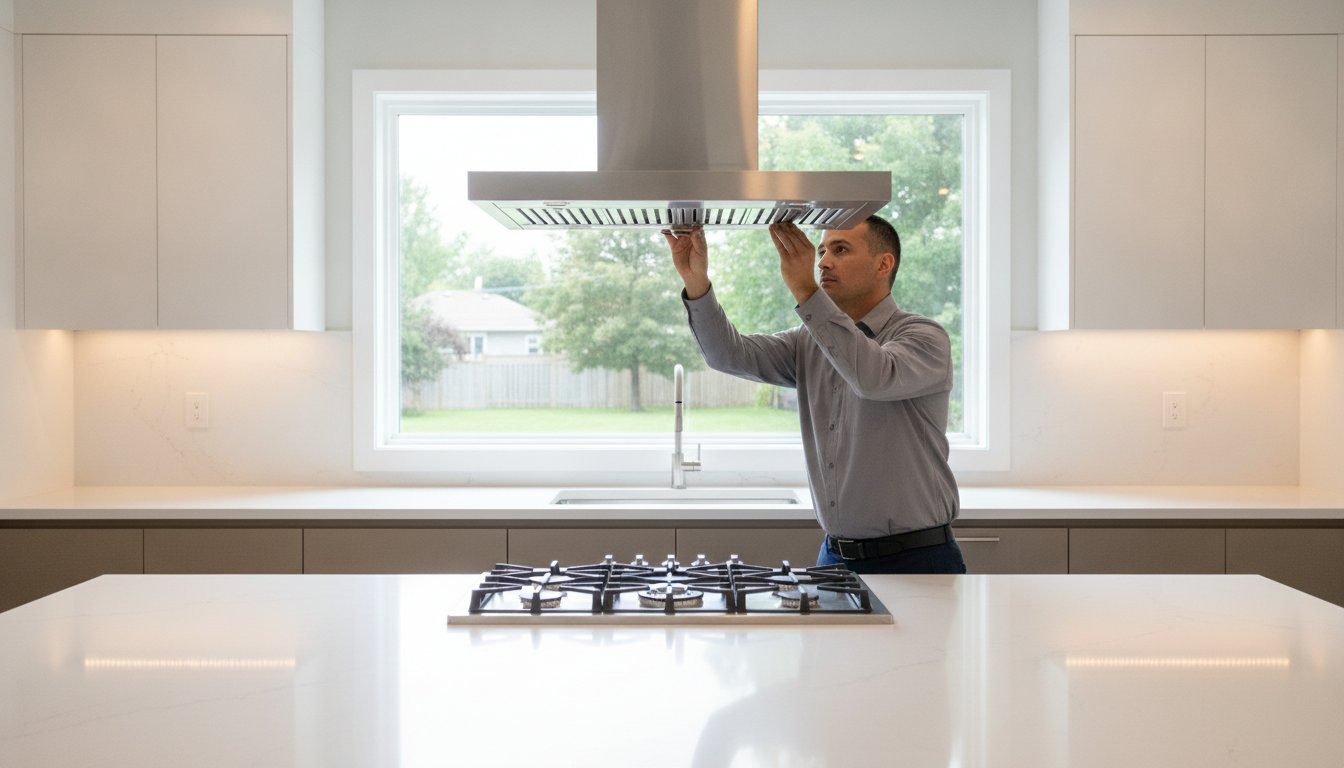
The height of your hood fan is a critical safety and performance factor. We typically mount the unit between 24 and 30 inches above the cooktop. If it is too high, it won’t capture smoke effectively; if it is too low, it becomes a fire hazard and gets in your way while cooking. We use precision levels to ensure the unit is perfectly symmetrical, providing that polished look you expect from a professional job. Before we consider the work finished, we run a full calibration test. We check the airflow at every speed setting and listen for any unusual vibrations. If you want to ensure your kitchen is safe and code-compliant, you can book your hood fan installation with our experienced team today.
Why Choose Honest Guys for Your Ottawa Hood Fan Installation?
Our name isn’t just a label; it’s the foundation of how we operate. When you book a hood fan installation Ottawa homeowners often worry about hidden costs or “surprises” hidden behind their drywall. We take a different approach. Before we start any work, we provide a clear, transparent assessment of your existing ductwork and electrical setup. If your current venting is safe and meets 2026 standards, we tell you. If it needs an upgrade to protect your home from moisture, we explain why in plain language. We believe that honesty is the only way to build lasting trust in our community.
Precision is at the heart of everything we do. Our extensive experience with dishwasher installation Ottawa has taught us that kitchen appliances require a delicate balance of electrical and structural knowledge. We bring that same level of meticulous detail to your ventilation. We also realize that your kitchen is the heart of your home. That is why we commit to leaving your space exactly as we found it, taking care to protect your countertops and flooring during the entire process. You shouldn’t have to clean up after the professionals you hired.
Local Expertise Across the National Capital Region
We’ve spent over 6 years serving diverse neighbourhoods across the Ottawa Valley. This local experience matters because housing styles vary wildly from one area to the next. We understand the specific structural challenges of the new builds in Stittsville and the intricate electrical configurations found in older Nepean bungalows. Whether you’re in a modern townhouse in Barrhaven or a spacious family home in Orleans, we arrive prepared for the unique quirks of your property. Our neighbourly approach means we treat your home with the same respect and care we would give our own.
Comprehensive Kitchen Support
Our skills extend beyond just moving air. We offer a full suite of services to keep your kitchen running smoothly, including expert electric stove repair Ottawa. This broad technical background allows us to spot potential issues with your cooking appliances before they become expensive problems. Because we are an owner-operated team, you get direct access to technicians who take personal accountability for their craftsmanship. From specialized gas appliance support to maintaining commercial coffee equipment, we provide the steady, reliable expertise that Ottawa families have come to trust.
Secure Your Kitchen’s Future with Expert Ventilation
A properly functioning kitchen is about more than just aesthetics; it is about protecting your home and your family. We have explored how the right CFM rating and insulated ducting prevent moisture damage while keeping your air clean. Whether you are installing a high-end chimney hood or a classic under-cabinet model, meeting the 2026 Ontario Building Code is essential for long-term peace of mind. You shouldn’t have to worry about lingering odours or attic condensation when you’re trying to enjoy a meal.
Our owner-operated team has spent over 6 years perfecting hood fan installation Ottawa services across the valley. From the modern developments in Kanata to the established neighbourhoods of Orleans, we bring specialized technical support for both residential and commercial appliances. We prioritize transparency and craftsmanship, ensuring your ventilation is calibrated for maximum efficiency and quiet operation. We treat every home with the personal accountability you expect from a local neighbour.
Ready to breathe easier in your kitchen? Request a Professional Hood Fan Installation in Ottawa. We look forward to helping you create a safer, more comfortable cooking environment for your household.
Frequently Asked Questions
How much does range hood installation cost in Ottawa?
Professional installation costs depend heavily on the complexity of the project. A straightforward replacement of an existing unit is simpler than a full installation that requires cutting through brick or running new electrical lines. Factors such as the type of hood, the length of the duct run, and any structural modifications will influence the final investment. We provide transparent assessments to ensure you understand exactly what is required for a safe, reliable setup in your home.
Do I need a permit to install a range hood in Ontario?
In the City of Ottawa, a simple replacement of an existing range hood usually does not require a building permit. However, if your project involves significant structural changes, such as cutting a new hole in a load-bearing wall or installing a brand-new electrical circuit, you may need one. It is always best to verify current municipal requirements or consult with a professional to ensure your project remains fully compliant with the Ontario Building Code.
Can I vent my hood fan through the wall instead of the roof?
You can absolutely vent through a wall, and it is often the most efficient choice for Ottawa homes. This method typically results in a shorter duct path with fewer elbows, which helps your fan maintain its rated power. When venting through a wall, we ensure the exterior cap is positioned high enough to avoid being blocked by heavy snow. This prevents moisture from backing up into your kitchen during our long winters.
What is the ideal height for a hood fan above a gas stove?
For a gas stove, the ideal height for a range hood is typically between 24 and 30 inches above the cooking surface. This range ensures the fan is close enough to capture heat and combustion byproducts effectively without becoming a fire hazard. If the hood is mounted too high, the suction will be insufficient. If it is too low, it can obstruct your view and potentially damage the unit’s internal components over time.
Why is my range hood making a loud vibrating noise?
Excessive vibration is usually caused by a loose mounting bracket, a buildup of grease on the fan blades, or a motor that has become unbalanced. In some cases, it may indicate that the ductwork was not secured correctly during the initial hood fan installation Ottawa project. We recommend inspecting the unit immediately to prevent further damage. Often, a simple adjustment or a thorough cleaning of the internal components can restore quiet, efficient operation.
Is it possible to install a ducted range hood where there is currently no vent?
It is entirely possible to install a ducted hood in a kitchen that currently has no exterior venting. This process involves cutting a precise opening through your home’s exterior wall or roof and installing rigid metal ductwork. While it is more complex than a simple swap, it is the best way to improve your indoor air quality. This is a common part of hood fan installation Ottawa projects where we map out efficient routes through cabinets.
How often should I clean or replace my range hood filters?
You should clean your grease filters every one to three months, depending on how often you cook. If you frequently sear meat or fry food, monthly cleaning is necessary to prevent grease from clogging the motor. Metal mesh or baffle filters can usually be washed in the dishwasher. If you use a recirculating system with charcoal filters, these cannot be cleaned and must be replaced every six months to keep your kitchen air fresh.
Do I need a licensed electrician for a hood fan installation?
While some homeowners attempt a DIY approach, hiring a professional for hood fan installation Ottawa is highly recommended for electrical safety. In Ontario, hardwiring an appliance to a dedicated circuit requires technical precision to meet safety standards. A professional ensures the wiring is grounded correctly and that the circuit can handle the fan’s power load. This prevents potential fire hazards and ensures your installation is fully compliant with the latest provincial electrical codes.