
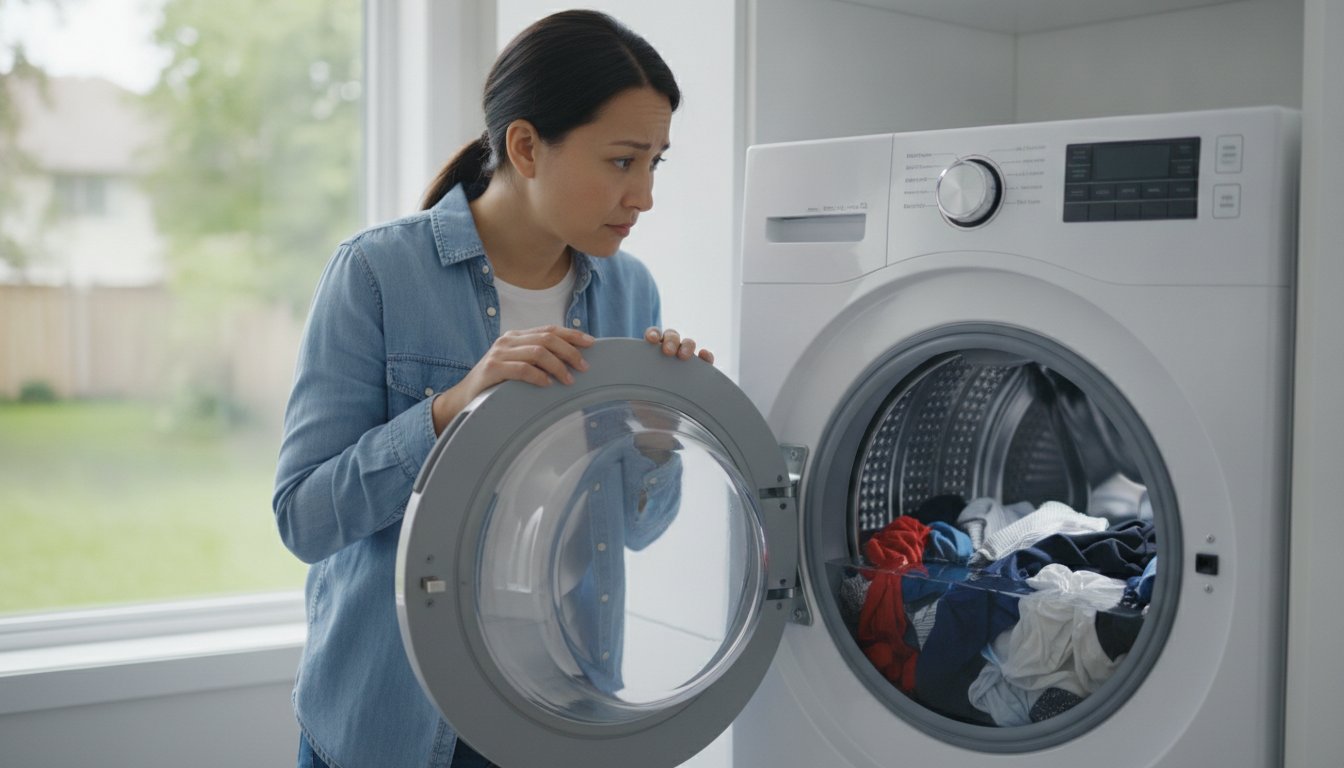
You open the lid expecting fresh, damp clothes ready for the dryer, but instead, you’re greeted by a heavy, dripping mess sitting in a pool of grey water. It’s a frustrating sight that usually happens at the worst possible time. If you are currently dealing with a washing machine not spinning in Ottawa, you know how quickly a broken appliance can throw your entire household routine into chaos. It is easy to feel a sense of dread about potential repair costs or the fear of being pressured into an expensive replacement that you do not actually need.
We understand that you just want your laundry room back in order without the stress of hidden fees or aggressive sales tactics. You deserve a clear, honest explanation for why your machine has stopped performing its most important job. This article provides the straight-talk you need to diagnose the issue using a logical, outside-in approach. We will explore common culprits like drainage blocks and unbalanced loads, offer troubleshooting steps you can try today, and help you decide when it is time to call in a professional for a reliable, fairly priced repair.
Key Takeaways
- Identify why your washer is leaving clothes soaking wet by understanding the link between drainage and the spin cycle.
- Learn how to fix an unbalanced load, the most common reason for a washing machine not spinning in Ottawa.
- Decode manufacturer error codes and perform a simple “sink test” to pinpoint mechanical failures.
- Master safe DIY resets that can clear temporary software glitches without the need for a service call.
- Get the honest facts on when to repair your appliance and when it makes more sense to replace it.
Why Your Washing Machine Stopped Spinning: An Ottawa Homeowner’s Guide
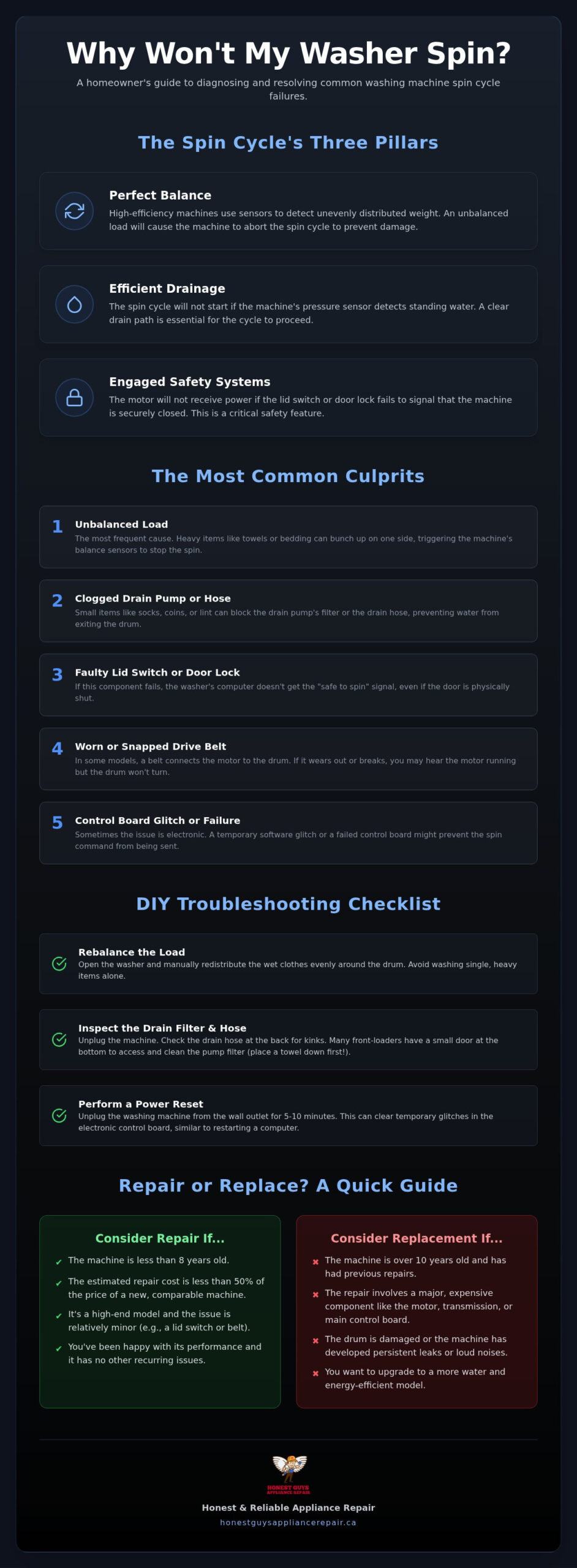
The spin cycle is the heavy lifter of your laundry routine. It requires high speeds, perfect balance, and efficient drainage to get the job done. When you find your washing machine not spinning in Ottawa, it is usually because one of these three pillars has collapsed. You might hear a rhythmic, loud thumping against the side of the cabinet; perhaps you hear just a low hum while the drum remains stubbornly still. In many cases, you’ll simply find a pool of cold water at the bottom of the tub. It’s a mess that stops your day in its tracks.
Ignoring this issue isn’t just about the inconvenience of heavy, dripping towels. In our local climate, especially during humid Ottawa summers, leaving soaking wet clothes in a dark drum is an open invitation for mould and mildew to take hold. Beyond the smell, an ineffective spin cycle forces your dryer to work twice as hard. This leads to higher electricity bills and premature wear on your dryer’s heating element. Resolving these drainage and rotation issues is an urgent priority for any household that values efficiency and hygiene.
The Mechanics of the Spin Cycle
To understand why it stopped, it helps to know How Washing Machines Work at a fundamental level. The control board acts as the brain, sending signals to the motor to engage the drive belt or direct-drive system. Modern machines are also packed with safety sensors. If the lid switch or door lock fails to engage, the system assumes the door is open and kills the power to the motor for safety. Similarly, if the pressure sensor detects standing water that hasn’t drained, the machine will refuse to enter the high-speed spin to prevent a flood. It is a protective measure that often looks like a total mechanical failure but is actually a software-driven safety stop.
Local Factors: Hard Water and Sediment
Living in specific areas like Greely or Stittsville brings unique challenges to your appliances. Many homes in these communities deal with higher mineral content in their water supply. Over time, calcium and magnesium deposits can build up inside the drain pump or the filter housing. This sediment can eventually seize the pump’s impeller, making it impossible for the machine to clear water. If the water doesn’t leave, the spin cycle won’t start. You might realize your neighbourhood’s water profile is the culprit if you notice white scale on your faucets or if your dishwasher is also struggling with sluggish drainage. Identifying these sediment-related clogs early can save you from a more expensive motor repair down the road.
The Most Common Culprits for Soaking Wet Laundry
Finding your laundry room in a state of disarray is never pleasant. If you are staring at a tub of water and a washing machine not spinning Ottawa homeowners often find that the cause falls into one of a few categories. While some issues require a toolkit and technical knowledge, others are simply a matter of how the machine is being used during the week.
One of the most frequent reasons modern high-efficiency (HE) washers stop mid-cycle is an unbalanced load. These machines are built with sensitive sensors to protect their internal components. If the system detects that the weight is unevenly distributed, it will abort the spin cycle to prevent the drum from damaging the frame or the outer tub. Similarly, a clogged drain pump acts as a gatekeeper. If the water cannot exit the tub, the control board will never trigger the high-speed rotation necessary to dry your clothes.
Mechanical wear is another common factor that stops the action. In older top-load or front-load models, a snapped or slipped drive belt is often the culprit. You might hear the motor spinning, but the basket remains motionless and heavy. There is also the “safety handshake” to consider. If the lid switch or door latch is faulty, the machine will not receive the signal that it is safe to engage the motor. You can find more detailed steps on identifying these specific parts in Maytag’s troubleshooting guide.
Electrical vs. Mechanical Failures
Is it a broken part or a computer glitch? A failed motor coupler or a worn-out clutch can physically stop the basket from turning even if the motor is healthy. You might notice a faint smell of burning rubber or hear a loud, rhythmic humming coming from the cabinet. However, sometimes the issue is the control board itself. As the “brain” of the appliance, it may simply fail to send the spin command at the right time. If you suspect a complex electrical issue is behind your washing machine not spinning Ottawa experts can provide a clear diagnostic to help you avoid replacing expensive parts unnecessarily. Getting a professional washer repair assessment is often the fastest way to find the truth.
The Hidden Danger of Oversized Loads
In many Kanata homes, we see washers struggling because of heavy rugs or king-sized comforters. These items soak up massive amounts of water, becoming incredibly heavy and difficult for the machine to shift. This often trips the balance sensor or, over time, wears out the suspension rods that hold the drum in place. When these rods fail, you will experience the “death dance” where the machine vibrates violently and bangs against the walls of your laundry room. It is important to distinguish between a one-time balance error caused by a single heavy item and a mechanical suspension failure that needs replacement parts to ensure the longevity of your machine in your neighbourhood.
Decoding Washer Error Codes and the ‘Sink Test’ Diagnostic
When your appliance starts flashing cryptic letters and numbers, it can feel like your laundry room is speaking a different language. These codes are the first clue in solving the mystery of a washing machine not spinning Ottawa residents often encounter during a busy week. For example, if you see “Ub” on a Samsung display or “uE” on an LG, the machine is telling you it cannot find its centre of gravity. It has detected an unbalanced load and stopped the cycle to prevent mechanical damage. Other signals like OE, 5d, or F21 are drainage alerts. These are critical because a washer that cannot empty its tub will never attempt to spin. It is vital to remember that error codes are guideposts for technicians, not always a final verdict.
The ‘Sink Test’: Is it Plumbing or the Washer?
In older Ottawa neighbourhoods like Nepean, the plumbing itself can sometimes be the culprit rather than the appliance. Before you assume the pump is broken, perform a simple “sink test” to rule out external blockages. Check if your kitchen or laundry sink is draining slowly. If the house’s main drain is partially obstructed, the washer’s high-pressure discharge can cause water to back up the standpipe, which triggers a drainage error in the machine. You should also realize that if your washer shares a drain line with a kitchen sink, a clogged garbage disposal can occasionally create enough back-pressure to confuse the washer’s sensors. If the sink is slow, the problem is likely in your pipes, not your motor.
Common Brand-Specific Spin Codes
Different manufacturers use their own shorthand for trouble, and knowing these can save you time. Samsung owners should look for DC, which indicates a door error, Ub for an unbalanced load, or 5C for a drainage blockage. Whirlpool and Maytag models often display “Sd” when there are too many suds in the drum. This excess foam creates “sud-lock,” preventing the motor from reaching spin speeds. You might also see F7E1, which points to a motor tachometer issue. For those with GE or Bosch units, codes like E23 or F21 usually indicate a lid lock failure or a motor drive fault. Identifying these signals helps you provide accurate information when seeking a professional washing machine not spinning Ottawa diagnostic, ensuring the technician arrives with the right tools for the job.
Quick DIY Fixes to Try Before Calling an Ottawa Repair Service
Before you resign yourself to a week at the laundromat, take a breath. Many cases of a washing machine not spinning Ottawa families deal with are actually simple fixes that don’t require a single replacement part. Safety is our first priority, so always unplug your appliance from the wall before you attempt any mechanical inspection. Once the power is off, you can safely explore these common “quick fixes” that often resolve the issue in minutes. It is about taking a logical approach to see if the machine just needs a small adjustment to get back to work.
Start with the simplest solution: the power-cycle reset. Modern washers are essentially computers that can occasionally suffer from software glitches. Unplug the machine for at least five minutes to allow the capacitors on the control board to discharge fully. Plug it back in and see if the error clears. You should also inspect your drain hose for a “high loop.” If the hose isn’t arched higher than the water level in the tub before it enters the standpipe, gravity can cause water to siphon back into the machine. This prevents the sensors from realizing the tub is empty, which stops the spin cycle from starting.
Redistributing the Load
If your machine stops mid-cycle with a heavy thumping sound, the load is likely “clumped.” Open the lid and manually move heavy items like wet towels or jeans to opposite sides of the drum. This balance is crucial for the high-speed rotation. While you are at it, check if your machine is level. Use a spirit level on the top of the cabinet and adjust the threaded feet until it sits perfectly flat. A machine that isn’t level will struggle to maintain balance. Finally, remember that “less is more” with detergent. Using too much soap creates excess foam, triggering a “Suds Lock” error that stops the motor to protect the internal components.
Clearing the Pump Filter (Front-Loaders)
Most front-load Samsung or LG washers have a small access door at the bottom front. This is where the pump filter lives, a common catch-all for coins, bobby pins, and Ottawa grit. To clean it, place a shallow tray or towel on the floor first. Locate the small emergency drain tube, pull the plug, and let the excess water empty into your tray. Once the water stops, unscrew the large mesh filter. You might be surprised by what you find inside. Give the mesh a thorough rinse under the tap to restore full drainage. If these steps don’t get your drum turning again, it is time to book a washing machine repair with a local expert who can handle the heavier mechanical work.
Professional Washing Machine Repair: When to Call the Honest Guys
Sometimes, despite your best efforts with filters and manual resets, the drum remains stubbornly still. If you see smoke, smell burning plastic, or hear the terrifying sound of metal grinding on metal, stop the cycle immediately. These are clear signals of serious mechanical or electrical failure that go far beyond a simple DIY fix. Continuing to run a faulty machine can lead to more expensive damage or even a safety hazard in your home. When you’re dealing with a washing machine not spinning Ottawa experts are your best line of defence to prevent a minor issue from becoming a total loss.
We believe in providing honest advice over making a quick sale. If your machine is over 10 years old and the repair cost starts to approach half the price of a brand-new unit, we’ll tell you. This “straight-talk” philosophy is why our customers trust us. We don’t want you pouring money into an appliance that’s reaching the end of its natural life. It’s often better to invest in a new Energy Star certified model if the internal bearings or the main control board have failed. Professional installation also ensures your new or repaired machine is perfectly balanced from day one, which prevents the long-term vibration issues that often lead to spin failures.
The Honest Guys Appliance Repair Advantage
As an owner-operated business, we take personal pride in every service call. We’ve developed deep expertise in major brands, offering specialized Samsung washer repair alongside service for LG and Whirlpool. Because we avoid aggressive sales tactics, you can expect a transparent diagnostic that focuses on the long-term reliability of your machine. We treat your laundry room with the same care we’d give our own because we’re part of this community. Our goal is to provide a sense of calm competence that makes your household problems feel solvable and manageable.
Serving Your Neighbourhood
We provide the reliable appliance repair Barrhaven and Kanata families have counted on for over six years. Our technicians understand the specific needs of local households, whether you’re dealing with hard water sediment in Greely or need a quick fix in Orleans. For more practical tips on keeping your laundry room functional and efficient, you can explore our washing machine repair Ottawa guide. We’re committed to keeping our neighbours’ homes running smoothly, providing the expert care you need to get your washing machine not spinning Ottawa back into its high-speed rhythm.
Restore Your Laundry Room Rhythm Today
A broken washer doesn’t have to mean a broken budget or a ruined week. By understanding the common causes and trying a few simple resets, you can often solve the problem without a major headache. Whether it was a simple “Suds Lock” or a more complex drainage issue, you now have the tools to identify the root cause and take action. You deserve a laundry routine that works for you, not against you.
If your troubleshooting hasn’t quite solved the mystery of your washing machine not spinning Ottawa, we are here to provide the expert, owner-operated service you deserve. With over 6 years of trusted local experience, we specialize in repairing major brands like Samsung, LG, and Whirlpool across Kanata, Nepean, Barrhaven, and the entire city. We prioritize transparency and straight-talk, ensuring you know exactly whether a repair or a replacement is in your best interest for the long term.
Book Your Transparent Washer Diagnostic in Ottawa Today to get a clear, honest assessment of your appliance’s health. You don’t have to deal with soaking wet laundry forever; let’s get your home running smoothly again.
Frequently Asked Questions
Is it safe to use my washer if it is making a loud banging noise during the spin cycle?
No, it isn’t safe to continue using a machine that makes a loud banging or thumping noise. This sound usually indicates that the suspension rods have failed or the tub bearing is worn out. If you keep running it, you risk the “death dance” where the unit moves across the floor, potentially damaging your walls, floor, or plumbing connections. It is best to stop the cycle immediately.
How do I know if my washing machine belt is broken?
You can tell a belt is broken if you hear the motor whirring or humming, but the drum stays perfectly still. Another quick test is to turn the drum by hand while the machine is off. If it spins very easily with zero resistance, the belt has likely snapped or slipped off the pulley. This is a common mechanical failure in older top-load and front-load models.
Can too much detergent prevent my washing machine from spinning?
Yes, using too much detergent is a leading cause of a washing machine not spinning Ottawa homeowners often overlook. This creates “Suds Lock,” where the pressure sensor detects a mountain of foam and assumes the tub is still full of water. The control board will then refuse to engage the high-speed spin to prevent a soapy overflow in your laundry room.
How much does it typically cost to fix a washer that won’t spin in Ottawa?
While prices vary based on the specific part needed, most washing machine repairs in the local market range between C$180 and C$520. The median cost for a completed repair is approximately C$277 according to recent industry data. Most professional services in the region also charge a standard diagnostic service call fee, which typically sits around C$89 plus tax to identify the root cause of the failure.
Why does my front-load washer leave my clothes soaking wet but no error code appears?
This often happens when the drain pump is working but is partially obstructed by small items like coins or bobby pins. The machine manages to drain enough water to satisfy the sensor eventually, but it takes too long to reach the high-speed spin phase. By the time the timer ends, the clothes haven’t been properly wrung out, leaving them heavy and dripping even without a formal error alert.
Does a clogged drain hose always mean I need a new pump?
Not at all. A clogged drain hose or a dirty pump filter is often a simple maintenance issue rather than a total mechanical failure. Before you assume you need a new pump, check the filter at the bottom front of your machine. Clearing out trapped debris can often restore full drainage and spin capability instantly, saving you the cost of a replacement part you didn’t actually need.
How long do washing machines usually last in Canadian households?
Most modern washing machines in Canadian households are designed to last between 10 and 12 years with proper maintenance. We generally recommend the “50% Rule” when deciding whether to fix an older unit. If a repair for a washing machine not spinning Ottawa costs more than half the price of a new appliance, it is often more financially sound to invest in a replacement instead.
What is the “High Loop” and why is it important for Ottawa plumbing codes?
A “High Loop” is a plumbing configuration where the drain hose is arched above the water level of the tub before entering the standpipe. This is important for meeting local standards because it prevents siphoning, which is when dirty water is sucked back into the machine from the drain. Without this loop, your washer may struggle to drain properly, leading to stagnant water and persistent drainage errors.